Editable 365 Day ADHD Daily Planner: Your Framework for Focus and Flexible Organization
For anyone navigating the unpredictable currents of attention deficit hyperactivity disorder, a standard planner often falls short. The blank pages can feel intimidating, the rigid structures suffocating, and the guilt of unused sections overwhelming. An Editable 365 Day ADHD Daily Planner approaches organization from a completely different angle. It isn’t just a calendar; it’s a customizable cognitive scaffold designed to work with the ADHD brain, not against it. Whether you are a professional juggling deadlines, a student managing coursework, or a creative entrepreneur tracking projects, this resource offers a tailored pathway to daily clarity without burnout.
Why Traditional Planners Fail the ADHD Brain
To appreciate the value of a specialized tool, it helps to understand the friction points. Standard planners rely heavily on linear time perception, consistent motivation, and memory recall — all areas where individuals with ADHD often struggle. Time blindness makes it difficult to sense the passing hours. Executive dysfunction turns task initiation into a monumental effort. Traditional layouts demand a level of sustained attention that simply isn’t always available.
An Editable 365 Day ADHD Daily Planner addresses these challenges by injecting flexibility into the framework. Because the file is editable, users can adapt the layout on their terms, stripping away overwhelming elements and amplifying what actually works. This isn’t about forcing yourself into a neurotypical mold; it’s about building an external brain that matches your unique wiring.
What Sets an Editable ADHD Planner Apart
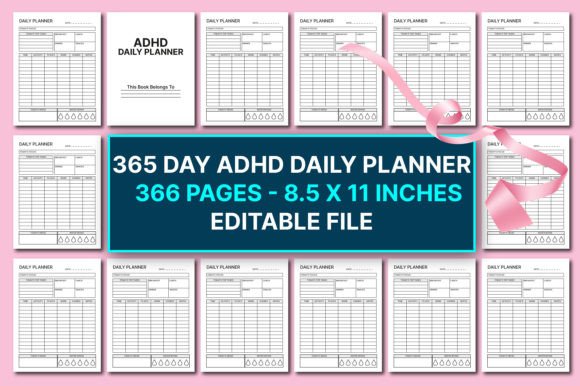
When you look at the core specifications — 366 pages formatted at 8.5 x 11 inches, without bleed, designed in CMYK color at 300 PPI — you are looking at a production-ready asset that has been meticulously prepared for clarity and consistency. But beyond the technical specs, the philosophy behind an editable layout is what creates lasting impact.
Flexibility Without Overwhelm
A fixed page can sometimes act as a silent critic. The editable nature of this planner means you can modify prompts, remove pressure points, or add personalized sections before you even print a single page. Hate the standard “hourly breakdown” because your energy spikes unpredictably? Remove it. Need a massive dopamine menu or a sensory check-in section? Add it. The ability to shape the planner before use transforms it from a passive container into an active partner in your routine.
Structured Yet Spacious Design
At 8.5 x 11 inches, each page provides ample room to sprawl, scribble, and think without feeling cramped. For an ADHD mind, tight spaces can subconsciously signal constraint, leading to avoidance. Generous dimensions invite you to externalize thoughts fully — list intrusive worries in the margin, map out a flow chart for a project, or track a single habit with oversized checkboxes. The layout, presented in vibrant CMYK color, utilizes visual segmentation to guide the eye gently, reducing the cognitive load required to parse information.
Who Benefits from a 365-Day ADHD Planning System
The audience for this resource is surprisingly broad. While explicitly designed with ADHD in mind, the editable framework serves anyone who craves adaptability over rigidity.
- Freelancers and Remote Workers: Without external office structures, self-directed planning becomes essential. The ability to edit the planner means you can create sprint-focused layouts for intense project weeks and more relaxed overview pages during slower periods.
- Students with Executive Function Challenges: Breaking down syllabi into manageable daily actions inside a customizable template prevents end-of-semester panic. Color-coding by subject within the editable file turns a chaotic schedule into a navigable map.
- Parents Managing Household Chaos: Tracking appointments, meal plans, children’s activities, and personal goals in one unified, editable system reduces the mental tab overload that leads to exhaustion.
- KDP Creators and Coaches: For those interested in the Editable 365 day ADHD Daily Planner For KDP Interiors angle, this product serves as a ready-to-upload interior. The high-quality print-ready PDF files meet Amazon’s technical requirements, allowing you to offer a thoughtful, niche resource to your own audience without rebuilding from scratch.
Real-World Ways to Use the Editable Planner Daily
Understanding a tool conceptually is one thing; embedding it into a lived experience is another. Here are several practical, experience-driven ways individuals integrate this editable planner into their routines.
Brain Dump Mornings
For the first ten minutes of the day, ignore the pre-printed prompts completely. Use the editable file to insert a blank “parking lot” section at the top of each daily page. Dump every swirling thought — urgent tasks, random memories, emotional check-ins — onto that space before engaging with the structured portion. This clears working memory and makes the actual prioritization feel less burdensome.
Task Slicing and Micro-Commitment
Ambiguity is the enemy of action for many with ADHD. Instead of writing “work on report,” which triggers avoidance, edit the planner to include a “tiniest next step” prompt. “Open document,” “type title,” “find one reference” are actions so small they bypass the brain’s resistance. The editable format lets you bake these micro-commitments directly into the daily view.
Dopamine Pairing Sections
Edit a corner of each page to include a “reward pairing” tracker. Mundane tasks can be paired with sensory pleasures — listening to a specific playlist while folding laundry, drinking a favorite tea during email time. The planner becomes a place to strategize motivation, not just list obligations.
Deep Dive: The KDP-Ready Interior Advantage
For creators, coaches, and publishers, the Editable 365 day ADHD Daily Planner For KDP Interiors represents a low-effort, high-value product opportunity. The files arrive as high-quality print-ready PDFs, fully tested for Kindle Direct Publishing. The specifications — 366 pages, 8.5 x 11 inches, no bleed, CMYK color, 300 PPI — eliminate the technical guesswork that often derails self-publishing projects.
What does this mean practically? You can upload directly, preview, and launch a physical planner without adjusting margins, converting color profiles, or wrestling with bleed settings. The interiors have been structured so that the printed result feels professional, cohesive, and visually calming. An included “Belongs To” page adds a personal touch, making the final product feel complete and giftable.
Why “No Bleed” Matters for User Experience
A planner without bleed simplifies printing at home as well. Users who prefer not to invest in a bound book can print pages individually, punch holes, and assemble a custom binder system. The no-bleed design ensures that nothing important gets trimmed awkwardly, preserving the integrity of trackers, habit grids, and note fields.
Features That Support Neurodivergent Needs
Picture opening a page that doesn’t punish you for inconsistency. The interior design reflects an understanding that ADHD brains thrive on novelty, clarity, and low-pressure scaffolding.
- 365-Day Continuity Without Forced Linearity: Having a full year’s worth of pages acknowledges the long game while allowing users to jump around as needed. Missed three months? No empty, guilt-inducing sections stare back — just a fresh page waiting to be used.
- Visual Calm, Not Sterility: The use of CMYK color maintains interest without overwhelming the visual cortex. Subtle color blocks can delineate priority levels or energy zones without screaming for attention.
- Consistent 300 PPI Print Quality: Sharp, crisp lines matter more than people realize. Fuzzy text or bleeding ink adds a layer of subconscious friction. At 300 PPI, every element reads clearly, reducing the minor irritations that can derail focus.
- Editable Fields for Personal Vocabulary: The ADHD community often develops its own language around productivity — “focus sprints,” “body doubling sessions,” “rejection sensitivity check-ins.” An editable planner lets you use your own words, making the tool feel more native and less clinical.
Overcoming Common Objections and Hesitations
Some people hear “editable daily planner” and assume it requires advanced design skills. In reality, the file formats used are typically compatible with free, accessible software. Basic text edits, inserting checkboxes, or swapping sections require no graphic design background. The learning curve is minimal, and the payoff — a completely personalized system — far outweighs the initial setup time.
Others worry that a 365-day structure might feel overly ambitious. It’s helpful to reframe this: the page count provides optionality, not obligation. Use every page, skip months, or print only the weeks you need. The resource serves you; you are not beholden to it.
Integrating the Planner into Broader ADHD Support Systems
An editable planner functions best as one component of a larger ecosystem. Pair it with external cues like visual timers, accountability check-ins, and environmental modifications for compounding benefits. The planner captures intention; the environment supports execution.
For therapists, coaches, and support group facilitators, recommending a customizable resource like an Editable 365 Day ADHD Daily Planner to clients offers a tangible tool to anchor abstract strategies discussed in sessions. Clients can bring pages to appointments, review what worked, and collaboratively adjust sections for the upcoming week.
Long-Term Value and Reusability
Unlike a bound, dated planner that expires annually, an editable digital file grants perpetual access. Each year, adjust the layout based on what you learned about yourself previously. Maybe last year’s rigid time-blocking section created shame; this year, replace it with an energy-based task list. The product grows with your self-awareness, making it a progressively more effective tool over time.
For KDP creators, this reusability translates into sustained commercial potential. Offer the planner as a timeless interior, repackage it with seasonal covers, or bundle it with other neurodivergent-friendly resources. The editable format multiplies the ways you can deliver value to your audience while building a catalog of inclusive, practical products.
Making the Decision: Is This Planner Right for You?
Evaluating suitability comes down to a few honest self-assessments. Do you abandon planners because they feel too prescriptive? Do you find yourself wishing you could tweak the sections to reflect your actual life rhythms rather than a generic ideal? Are you trying to support clients, students, or family members who need structure without shame? If so, the editable approach aligns closely with those realities.
The combination of professional print specifications — 8.5 x 11 inches, no bleed, CMYK, 300 PPI — and the empathetic, ADHD-informed design philosophy creates a rare convergence of practicality and psychological safety. It’s a resource built not on the assumption of flawless executive function, but on the acknowledgment that good days and hard days share the same pages, and both deserve a tool that meets you where you are.
Whether you print it once, rebind it quarterly, or upload it as a KDP interior to share with thousands, this 366-page editable framework becomes whatever you need it to be. And for the ADHD mind, that permission to define your own structure might be the most valuable feature of all.