Finding the Right Productivity Planner KDP Interior for Your Self-Publishing Business
In the competitive landscape of Amazon Kindle Direct Publishing (KDP), the presentation of your book is paramount. While content is king, the interior design—the layout, formatting, and visual structure of your pages—is the castle that houses it. For creators focusing on low or no-content books, like planners, journals, and trackers, this interior is the primary product. The term "Productivity Planner KDP Interior" refers to a specialized, pre-designed digital template specifically crafted for publishing productivity-focused planners on Amazon's platform.
What Distinguishes a Purpose-Built KDP Interior?
A generic template and a dedicated Productivity Planner KDP Interior serve fundamentally different purposes. A basic document template might provide margins and page numbers. A professional KDP interior, however, is engineered with the specific constraints and opportunities of the Kindle ecosystem in mind. This includes precise formatting for Amazon's digital and print-on-demand requirements, a structure that enhances usability (such as clearly labeled sections for daily, weekly, and monthly planning), and a design aesthetic that aligns with the expectations of the productivity niche.
Key distinctions often include thoughtfully placed checkboxes, habit trackers, goal-setting pages, and reflection areas. The design is not merely decorative; it facilitates function. Furthermore, a true KDP interior is typically provided as an editable file, allowing you to customize elements like cover pages, titles, or specific sections before uploading, giving you a balance between a ready-to-use foundation and necessary adaptability.
Evaluating File Formats and Practical Flexibility
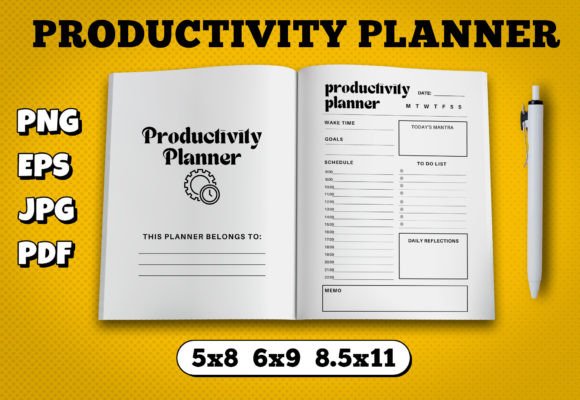
A critical aspect of comparing these resources is the bundle of file formats provided. A robust offering, for example, might include 5x8, 6x9, and 8.5x11 sizes in JPG, PNG, EPS, and PDF without bleed. This variety addresses several practical needs.
The PDF file, ready for KDP upload, is the core deliverable. However, the inclusion of JPG and PNG images allows for easy previews, social media marketing, or use in other promotional materials. EPS files offer scalability for potential future graphic modifications. Offering sizes without bleed is specifically tailored for the interior manuscript, whereas files with bleed are necessary for cover design. This comprehensive approach saves significant time, as you aren't forced to convert or resize files yourself, which can introduce formatting errors.
The utility often extends beyond direct KDP publishing. As many descriptions note, these interiors can also be used for physical printing, personal writing, or as a base for other digital projects. This flexibility can be a major advantage for a publisher exploring multiple channels or testing concepts before a full KDP launch.
Strengths and Potential Tradeoffs of a Pre-Designed Interior
The primary strength of using a Productivity Planner KDP Interior is efficiency. It eliminates the need to learn complex graphic design software or master KDP's precise formatting guidelines. You receive a polished, professional product foundation instantly, allowing you to focus on marketing, series creation, or business scaling. For newcomers to self-publishing, this can dramatically lower the barrier to entry and reduce initial anxiety about technical details.
There are, however, tradeoffs to consider. The first is uniqueness. A popular, well-made interior might be purchased and used by many publishers, leading to similar-looking books in the marketplace. Customization can mitigate this, but it requires some design skill. Secondly, the interior's structure might not perfectly fit a highly novel planner concept. If your productivity system requires a unique page flow or specialized tracking elements not in the template, you may need to invest in custom design.
Another consideration is cost versus value. While purchasing an interior is far less expensive than hiring a designer, it is an upfront cost. You must evaluate whether the template's quality, flexibility, and included formats provide enough value to justify the investment compared to free, basic templates or the time cost of building your own.
When Is a Productivity Planner KDP Interior the Right Choice?
This solution is often an excellent fit for specific situations. If you are new to KDP and want to launch a professional-quality product quickly, it provides a reliable path. If your business strategy involves creating multiple volumes or variations (like a weekly planner, a monthly planner, and a goal tracker), using a consistent, editable interior as a base can ensure brand cohesion and speed up production.
It is also a strong choice when your expertise lies in marketing and niche selection rather than graphic design. You can leverage the designer's skill in user experience layout while applying your own knowledge to target the right audience for the planner.
When Might You Need Another Option?
A pre-designed interior may not be the best fit if your planner concept is exceptionally innovative or complex. Highly specialized tools, like planners for specific professional methodologies or integrated systems with unique symbols and layouts, often require a bespoke design. In such cases, collaborating with a graphic designer familiar with KDP might yield a better result.
Similarly, if you possess strong design skills and enjoy the creative process, building your own interior from scratch could offer greater control, uniqueness, and potentially lower long-term costs if you plan for a large catalogue. Also, if you are testing the market with a very simple, minimal-concept notebook, a free or extremely basic template might suffice for a first experiment.
Making an Informed Decision: Key Factors to Weigh
To choose wisely, focus on factors beyond just the visual preview. First, examine the technical specifications. Ensure the provided page sizes match the trim sizes you intend to publish on KDP. Confirm the files are truly "ready to upload"—meaning they have correct margins, embedded fonts (if any), and are in the required PDF format.
Second, assess the editability. How much of the interior can you realistically change? Can you alter section headers, add pages, or change the color scheme of elements? This flexibility determines how much you can differentiate your final product.
Third, consider the design's usability. Look past aesthetics and evaluate the layout from a user's perspective. Is the weekly spread intuitive? Are writing spaces adequate? A good productivity planner interior should solve organizational problems for the end-user, not just look attractive.
Finally, think about the seller's broader catalogue. As many shops note, they offer other interiors like journals, organizers, and trackers. If you plan to expand your KDP business into adjacent niches, using interiors from a consistent source can help maintain a coherent design language across your entire brand, potentially building recognizability with your customers.
By approaching the decision with a focus on these practical, business-oriented factors, you can move beyond superficial comparison and select a resource that genuinely supports your goals in the self-publishing marketplace. The right Productivity Planner KDP Interior acts not just as a template, but as a foundational tool for building and scaling your publishing venture.