Evaluating D Word Search Puzzles for KDP 1: A Professional Resource for Content Publishers
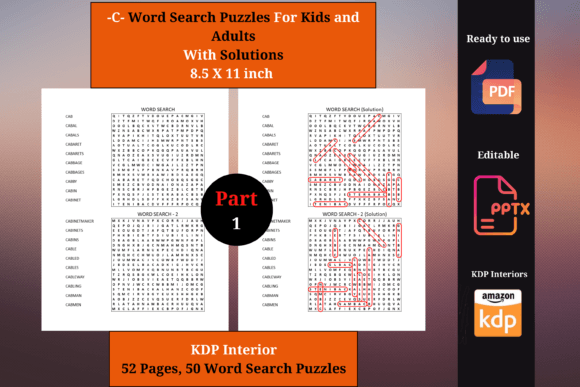
For creators looking to publish on Amazon's Kindle Direct Publishing (KDP) platform, sourcing reliable, high-quality interiors is a fundamental step. The product known as D Word Search Puzzles for KDP 1 represents a specific solution in this niche, offering a ready-made collection of puzzles designed for immediate use. Its primary value lies in its structured composition: it provides a substantial bank of 3700 words beginning with the letter "C," segmented into manageable parts, with the first part containing 500 of those words. This organization transforms a broad concept into a practical, deployable asset.
Core Characteristics and Practical Functionality
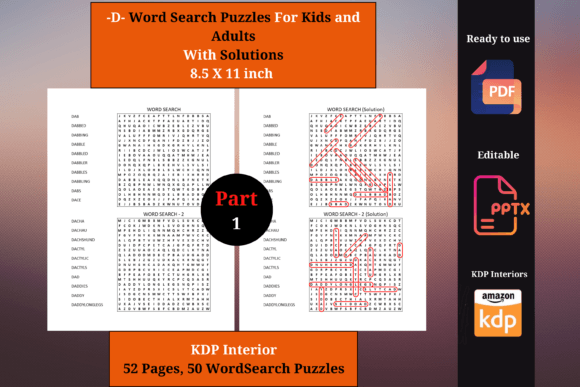
The resource is defined by several key features. It delivers 50 distinct word search puzzles, complete with corresponding solution pages. This duality is crucial for user satisfaction, as it allows for a complete product offering. The puzzles are tiered into both kids and adults difficulty levels, which broadens its potential market application. From a technical standpoint, it is provided as both a PDF file for direct use and an editable PPTX file, granting flexibility. The standardized size of 8.5 x 11 inches ensures compatibility with common KDP interior formatting requirements.
What makes D Word Search Puzzles for KDP 1 worth discussing is its focus on a single lexical theme—words starting with "C." This thematic consistency can be a strength for targeted publications or educational materials focusing on vocabulary building, phonics, or specific subjects. The large word bank suggests a depth of content that mitigates the risk of repetition across the 50 puzzles, a common limitation in lesser collections.
Assessing Quality and Usability in Real-World Application
In practical use, the quality of such a product hinges on the curation of the word list and the puzzle construction. A list of 3700 "C" words implies significant research or compilation effort, offering a resource many individual creators would not feasibly develop themselves. The editable PPTX file is a notable strength; it allows professionals to adjust difficulty, modify layouts, or rebrand the puzzles to fit a specific series or audience, adding long-term value beyond a single publication.
For performance, the inclusion of solutions pages directly addresses a user need, enhancing the product's completeness. The dual-level approach (kids and adults) increases its versatility. An educator might use the simpler puzzles in a classroom setting while offering the adult-level ones as supplementary material or for different age groups. A publisher could split the content across multiple low-content books or compile it into a larger volume.
Who Benefits Most from This Resource?
The audience that may derive the greatest benefit includes KDP publishers specializing in low-content or activity books, educators creating custom worksheets, and small business owners offering printable games. Its utility is particularly evident for those seeking to expedite their workflow. Instead of manually generating puzzles and word lists, which is time-consuming and requires specific software skills, this product provides a foundational template. Freelancers designing materials for clients could also use the editable files to deliver tailored work efficiently.
A possible limitation to consider is the specificity of the theme. While a deep dive into "C" words is excellent for certain projects, it may not be as universally applicable as a more generalized word search collection. The publisher's target audience must have an interest in or need for this focused vocabulary set. Furthermore, the quality of the puzzle design—such as grid size, word overlap, and font clarity—will ultimately determine user engagement, aspects that must be evaluated upon receipt of the actual files.
Professional Observations on Flexibility and Long-Term Value
The provision of an editable PowerPoint file significantly elevates the resource's flexibility. It allows for adjustments in branding, difficulty scaling by removing or adding words, and integration with other materials. This adaptability means D Word Search Puzzles for KDP 1 can serve multiple projects over time, not just a single publication. For a serious hobbyist or entrepreneur building a portfolio of puzzle books, this represents a cost-effective starting point.
The division of the 3700 words into 8 parts suggests a serialized approach. Part 1, with its 500 words and 50 puzzles, could function as a standalone book or as the first installment in a series. This structure aids in project planning and market testing. A publisher could release Part 1, gauge interest, and then commit to subsequent parts based on performance.
In conclusion, D Word Search Puzzles for KDP 1 presents a professionally packaged content asset with clear practical application. Its strengths are its thematic depth, ready-to-use and editable formats, and inclusion of solutions. Its fit depends largely on whether a creator's project aligns with its specific lexical focus. For those targeting vocabulary development, themed activity books, or efficient KDP publishing, it offers a tangible resource that can save development time and provide a consistent, reliable foundation for publication.